 MediRec
1. Purpose
Access regulation is one of the critical bottlenecks in public health management. The volume of referrals, fragmented workflows, and the administrative burden on health professionals compromise both system efficiency and the quality of patient care. MediRec was created to address this challenge — integrating technology, listening to health professionals, and deep knowledge of SUS processes to transform regulation into an agile, traceable, and patient-centered flow.
The platform is built hand in hand: on one side, the 2BLP Futuro team; on the other, the Municipal Health Department itself — from central management to front-line operators. This co-construction process ensures that every feature responds to real day-to-day needs at the facilities, making MediRec not only a technological tool but a shared project for the continuous improvement of the health system. The relationship with the front line remains strong, and many of the new requirements incorporated into the platform arose directly from needs brought forward by the professionals who use it day to day.
Consistent with this co-construction model, 2BLP Futuro maintains its commitment to network autonomy through the Technology Ownership Program, which provides for the possibility that the municipality may progress toward a perpetual license of use, with the source code held in custody. This ensures that the results of the joint work with front-line professionals are converted into installed capacity within the public network itself. The program's terms and conditions are detailed under Ownership.
The trends observed in the first report are confirmed in this one. This reinforces the consistency of the results and the soundness of the adoption model.
2. MediRec
MediRec is a health management platform developed by 2BLP Futuro Ltda., focused on automating and optimizing access-regulation processes in the public health network. Conceived in close collaboration with health professionals, the solution was designed to adapt to the workflows already in place at the facilities, reducing the administrative burden and increasing the efficiency of patient care. Since the first report, the platform has expanded its scope: new integrations and features have been incorporated, many of them arising directly from needs brought forward by front-line professionals.
One of MediRec's central pillars is its native integration with SISREG — the Ministry of Health's National Regulation System. Through this integration, professionals submit referrals and counter-referrals directly through the platform, which synchronizes the information with SISREG in real time, eliminating duplicate data entry, reducing inconsistencies, and preserving the continuity of the care pathway.
Request quality is reinforced by an analysis mechanism based on the public health network's clinical protocols. At the time of registration, the system compares the clinical information entered by the professional with the criteria in the current protocols, guiding the professional on the referral's suitability even before it is sent to the regulator. This assisted process increases request compliance, reduces return rates and administrative rework, shortens patient waiting time, and supports the requesting professional's continuous clinical development.
MediRec identifies and tracks the teams responsible for each case and request, allowing it to automatically filter returned referrals and directly notify the team responsible for resolving them. Each team begins to receive, autonomously, alerts related to its own returns — with all the information needed to act immediately, without depending on administrative screening or intermediation. The result is a more agile, transparent, and patient-centered regulation network, with significant gains for professionals, managers, and, above all, those waiting for care.
MediRec also extends its work to health surveillance, supporting teams in monitoring cases that require follow-up and timely action. The surveillance dashboard consolidates, in a single view, notification and follow-up cases from the various integrated systems, allowing each team to quickly identify the situations under its responsibility, prioritize pending items, and act promptly on patients who require surveillance. This follow-up does not end on the screen: it continues in the team dynamics that characterize Primary Care. In team meetings, dashboard data guide case discussions and the assignment of responsibilities, while the CHW home-visit scorecard translates surveillance into concrete action in the territory, tracking completed visits and encouraging active care close to the population.
In addition to SISREG, MediRec integrates, among others, SER, GAL, SISCAN, SINAN Rio, SINAN Online, SiTE-TB, IL-TB, SISAB, Bolsa Família (SUBPAV), TJRJ, eSUS, and laboratory test results, with future integration planned for HCI, the other SINAN systems, and SIPNI. The updated map of completed and planned integrations is available under Integrations. The results obtained with MediRec in the network's facilities demonstrate a concrete and measurable impact on care efficiency.
3. MediRec users
MediRec serves every professional profile at a health facility — physicians, nurses, pharmacists, community health workers, dentists, technicians, administrative staff, NASF/eMulti teams, managers, and directors. Each category accesses a set of features developed specifically for its responsibilities, viewing only the information relevant to its role. This segmented access model simultaneously ensures each professional's operational agility and compliance with the privacy and data-protection principles established by the LGPD.
The 12,125 front-line users are distributed by role and Planning Area:
| Role | 1.0 | 2.1 | 2.2 | 3.1 | 3.2 | 3.3 | 4.0 | 5.1 | 5.2 | 5.3 | Central | Total |
|---|---|---|---|---|---|---|---|---|---|---|---|---|
| Community health workers | 0 | 342 | 312 | 1223 | 641 | 1003 | 651 | 885 | 831 | 593 | 1 | 6482 |
| Physicians | 1 | 79 | 99 | 265 | 148 | 257 | 152 | 175 | 162 | 114 | 0 | 1452 |
| Nurses | 5 | 70 | 71 | 271 | 133 | 229 | 129 | 161 | 160 | 95 | 0 | 1324 |
| Nursing technicians | 0 | 58 | 37 | 11 | 44 | 109 | 83 | 66 | 51 | 15 | 0 | 474 |
| Dentists | 0 | 38 | 20 | 66 | 41 | 66 | 43 | 56 | 47 | 36 | 0 | 413 |
| Administrative staff | 0 | 22 | 12 | 36 | 48 | 69 | 58 | 55 | 38 | 67 | 0 | 405 |
| Regulators | 8 | 18 | 26 | 64 | 32 | 62 | 24 | 23 | 5 | 13 | 77 | 352 |
| Managers | 3 | 18 | 9 | 37 | 25 | 33 | 24 | 35 | 42 | 28 | 1 | 255 |
| Medical technical leads | 25 | 14 | 9 | 30 | 24 | 32 | 21 | 33 | 42 | 22 | 0 | 252 |
| Nursing technical leads | 8 | 10 | 7 | 15 | 16 | 37 | 16 | 29 | 26 | 22 | 0 | 186 |
| eMulti | 0 | 7 | 1 | 32 | 13 | 1 | 9 | 8 | 5 | 1 | 0 | 77 |
| Psychologists | 0 | 12 | 6 | 4 | 6 | 6 | 2 | 16 | 12 | 1 | 0 | 65 |
| Oral health assistants | 0 | 2 | 9 | 1 | 10 | 9 | 9 | 14 | 6 | 4 | 0 | 64 |
| Physical therapists | 0 | 8 | 1 | 3 | 1 | 13 | 0 | 17 | 5 | 2 | 0 | 50 |
| Oral health technicians | 0 | 6 | 3 | 3 | 9 | 5 | 11 | 8 | 2 | 1 | 0 | 48 |
| Directors | 1 | 5 | 2 | 2 | 4 | 7 | 6 | 2 | 5 | 5 | 0 | 39 |
| Pharmacists | 0 | 6 | 8 | 0 | 5 | 4 | 5 | 6 | 1 | 4 | 0 | 39 |
| Nutritionists | 0 | 2 | 5 | 0 | 6 | 0 | 1 | 11 | 5 | 3 | 0 | 33 |
| Social workers | 0 | 1 | 4 | 3 | 2 | 4 | 0 | 10 | 2 | 0 | 0 | 26 |
| NIR administrative staff | 0 | 0 | 0 | 0 | 0 | 19 | 0 | 0 | 0 | 0 | 0 | 19 |
| Physical education professionals | 0 | 0 | 3 | 0 | 3 | 2 | 1 | 5 | 2 | 0 | 0 | 16 |
| Pharmacy technicians | 0 | 1 | 1 | 0 | 2 | 3 | 3 | 6 | 0 | 0 | 0 | 16 |
| Social action workers | 0 | 2 | 1 | 0 | 0 | 4 | 3 | 0 | 0 | 3 | 0 | 13 |
| Speech therapists | 0 | 0 | 0 | 0 | 0 | 3 | 0 | 4 | 2 | 0 | 0 | 9 |
| Regulation technicians | 0 | 0 | 0 | 0 | 0 | 0 | 0 | 0 | 0 | 0 | 6 | 6 |
| Receptionists | 0 | 0 | 0 | 0 | 0 | 0 | 0 | 0 | 0 | 0 | 5 | 5 |
| Pharmacy assistants | 0 | 0 | 0 | 0 | 0 | 2 | 0 | 0 | 0 | 0 | 0 | 2 |
| Psychiatrists | 0 | 2 | 0 | 0 | 0 | 0 | 0 | 0 | 0 | 0 | 0 | 2 |
| Occupational therapists | 0 | 0 | 0 | 0 | 0 | 1 | 0 | 0 | 0 | 0 | 0 | 1 |
The 269 CAP users are distributed by area and team:
| AP | Team | Number |
|---|---|---|
| 1.0 | Lines of Care 1.0 | 4 |
| 1.0 | NIR 1.0 | 4 |
| 1.0 | Coordination 1.0 | 1 |
| 2.1 | Lines of care 2.1 | 15 |
| 2.1 | DAPS 2.1 | 3 |
| 2.1 | NIR 2.1 | 2 |
| 2.1 | Administrative | 1 |
| 2.1 | OS 2.1 | 1 |
| 2.2 | Lines of Care 2.2 | 14 |
| 2.2 | CAP 2.2 | 9 |
| 2.2 | NIR 2.2 | 3 |
| 2.2 | Administrative | 2 |
| 2.2 | Dentistry | 1 |
| 2.2 | Mental Health | 1 |
| 3.1 | NIR 3.1 | 9 |
| 3.1 | Lines of Care 3.1 | 6 |
| 3.1 | CAP 3.1 | 2 |
| 3.2 | NIR 3.2 | 13 |
| 3.2 | DAPS 3.2 | 12 |
| 3.2 | Dentistry | 1 |
| 3.3 | Lines of Care 3.3 | 13 |
| 3.3 | NIR 3.3 | 8 |
| 3.3 | DVS 3.3 | 4 |
| 3.3 | DICA 3.3 | 3 |
| 3.3 | Coordination 3.3 | 1 |
| 4.0 | DAPS 4.0 | 13 |
| 4.0 | DVS 4.0 | 12 |
| 4.0 | CAP 4.0 | 6 |
| 4.0 | NIR 4.0 | 5 |
| 4.0 | Lines of Care 4.0 | 2 |
| 5.1 | DAPS 5.1 | 26 |
| 5.1 | DVS 5.1 | 10 |
| 5.1 | DICA | 7 |
| 5.1 | Administrative | 4 |
| 5.1 | NIR 5.1 | 3 |
| 5.1 | Lines of Care 5.1 | 2 |
| 5.1 | Women's Health Line 5.1 | 1 |
| 5.1 | Ombudsman's Office | 1 |
| 5.2 | Lines of care 5.2 | 9 |
| 5.2 | NIR 5.2 | 9 |
| 5.2 | CAP 5.2 | 4 |
| 5.2 | Administrative | 2 |
| 5.3 | NIR 5.3 | 8 |
| 5.3 | Lines of Care 5.3 | 4 |
| 5.3 | CAPSI 5.3 | 2 |
| 5.3 | DAPS 5.3 | 2 |
| 5.3 | DVS 5.3 | 2 |
| 5.3 | Coordination | 1 |
| 5.3 | DICA 5.3 | 1 |
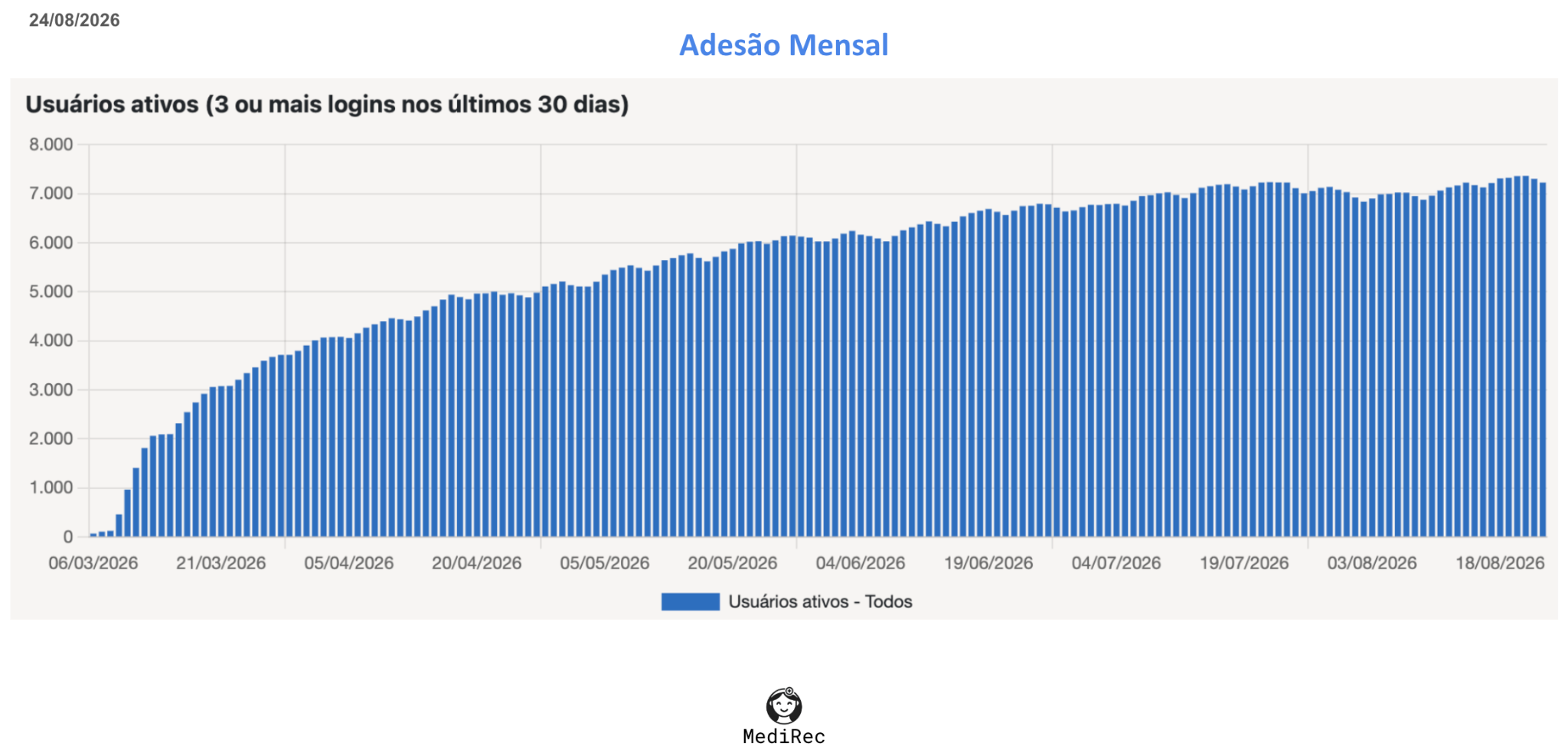
The number of daily active users remains constant, above 7,000 per day — approximately 57% of registered users.
4. More than 8 to 12 hours saved per physician each week
In July 2025, MediRec needed approximately 20 seconds to submit a referral to SISREG. In March 2026, after an initial technological improvement, it needed 10 to 13 seconds for the same referral. Today, after the latest version of our integration infrastructure, it needs only 6 seconds.
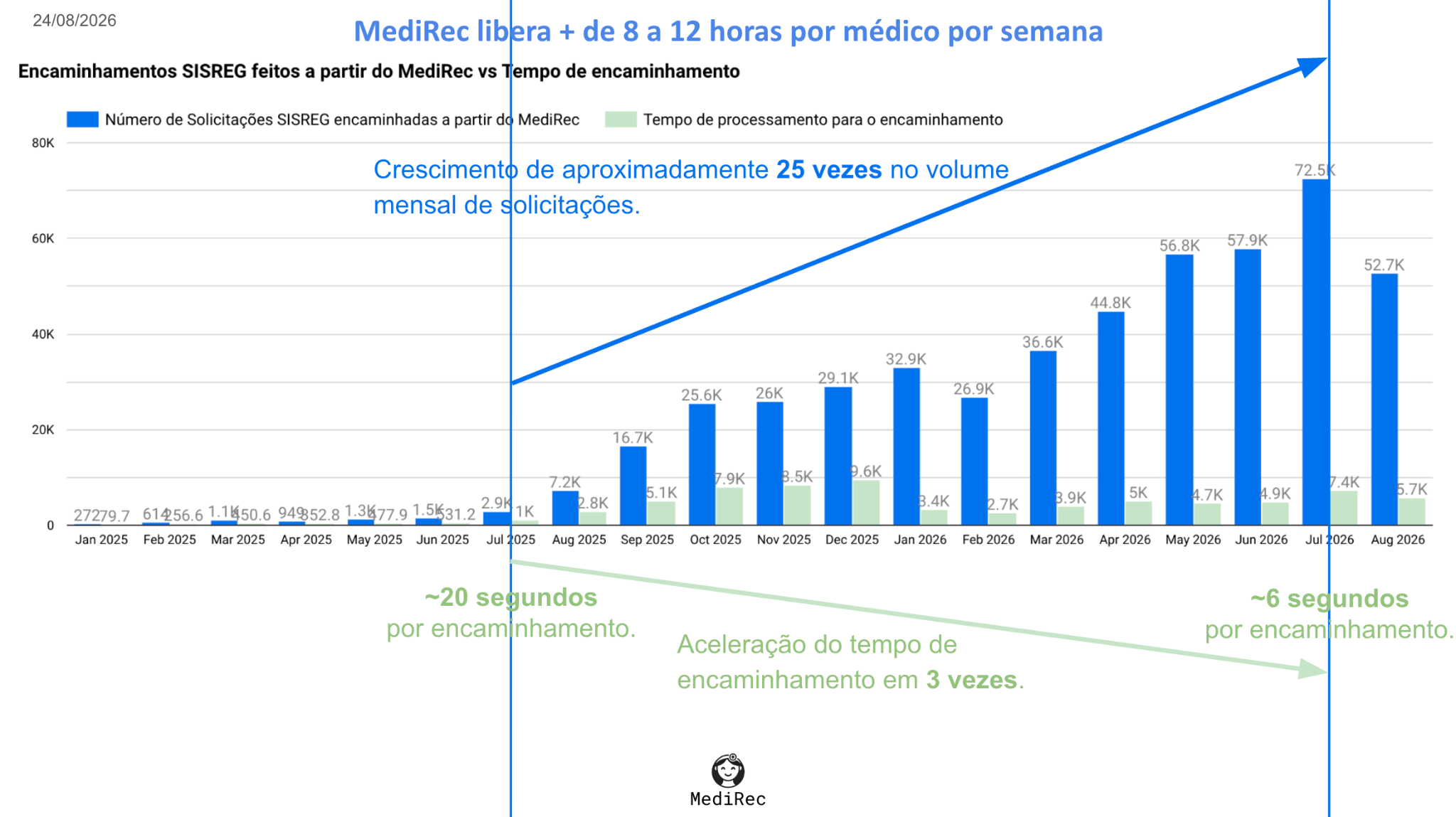
In April and May 2025, in an assessment conducted by SAP itself with the medical teams at the Zilda Arns facility, savings of 8 to 12 hours per physician per week were estimated, varying according to request volume and the facility's level of care pressure. Because referral time has since fallen to 6 seconds, these savings are likely to be even greater today. Applied to the 2,311 physicians, regulators, and Medical Technical Leads registered in MediRec, this represents 18,488 to 27,732 hours saved per week. Projected over the entire year (47 weeks, excluding vacation), it represents 868,936 to 1,303,404 hours of physician time saved per year — the equivalent of having 400 to 700 additional physicians working in the network.
5. Up to a 47% reduction in the municipal returned-referral backlog
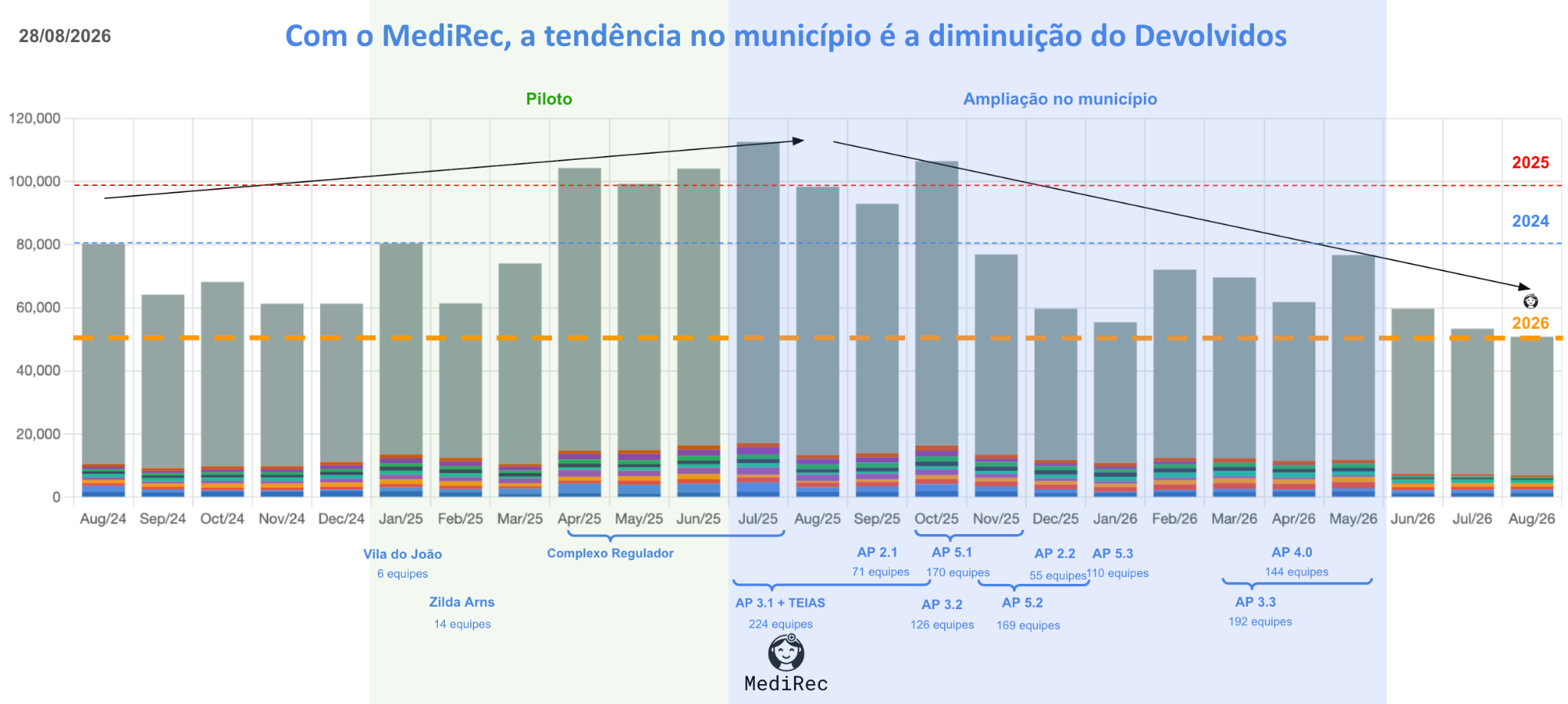
In the areas and facilities that adopted the returned-referrals module, a reduction of up to 65% was observed in the accumulated backlog of returned referrals. At the municipal level, considering the disparity in adoption and use rates, a year-over-year reduction of up to 50% is observed.
This result is enabled by three innovations presented in the previous report: automating the filtering process by facility, team, and requester; notification and signaling mechanisms for returned referrals; and eliminating the phenomenon of ownerless returns. Since then, we have introduced a fourth innovation: automatically identifying the reason for the return, which allows each professional category to recognize its responsibilities and immediately take the appropriate action.
Ownerless returns are requests returned by professionals who no longer belong to the facility. Before MediRec, identifying them required a specific manual effort; MediRec automatically assigns them to the appropriate teams, integrating them into the normal handling workflow.
Despite month-to-month fluctuations, the observed trend is clear: the Planning Areas and facilities that use MediRec progressively reduce their backlog of returned referrals, while those that do not use the platform show an upward trend.
6. A drop of more than 50% in the return rate
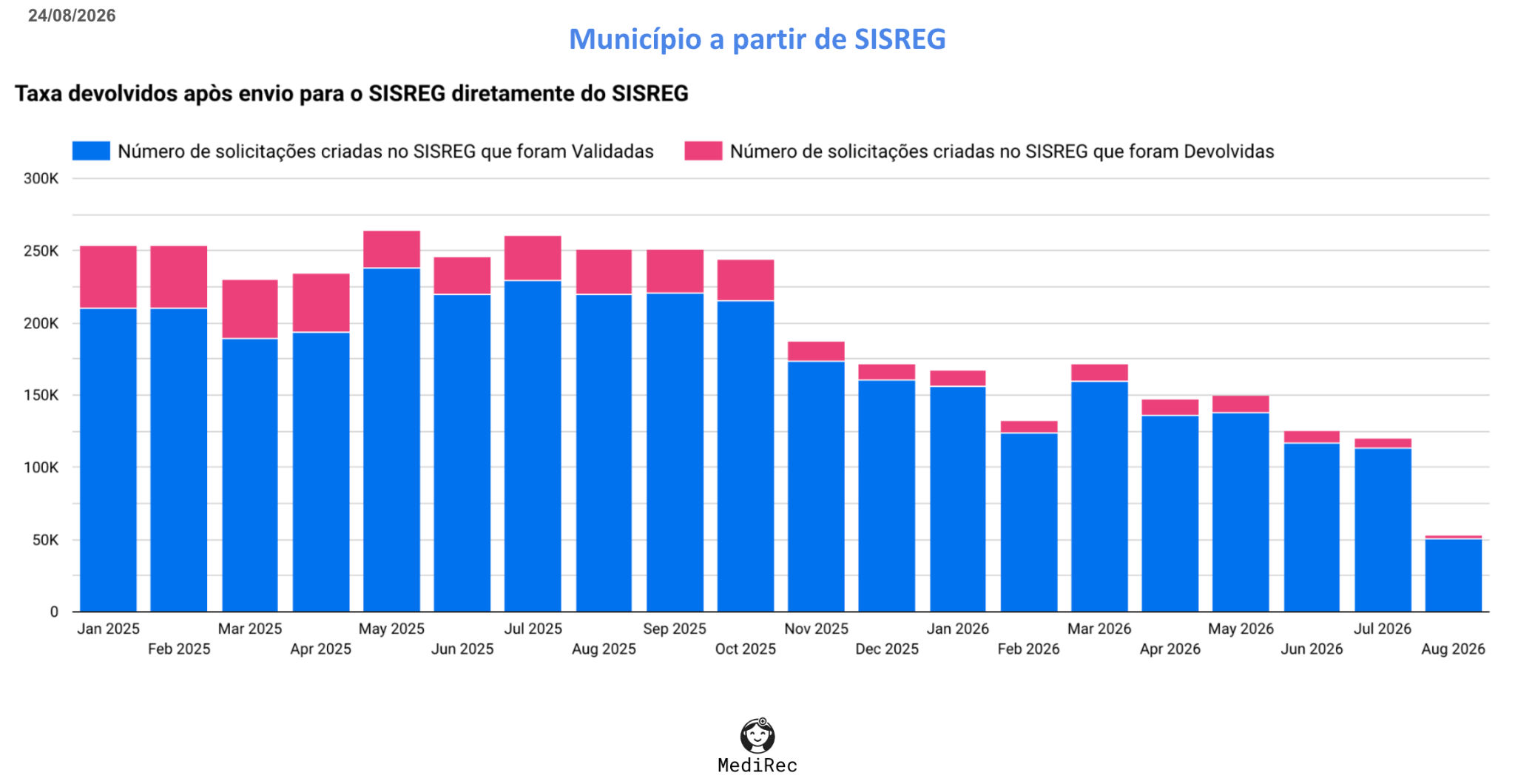
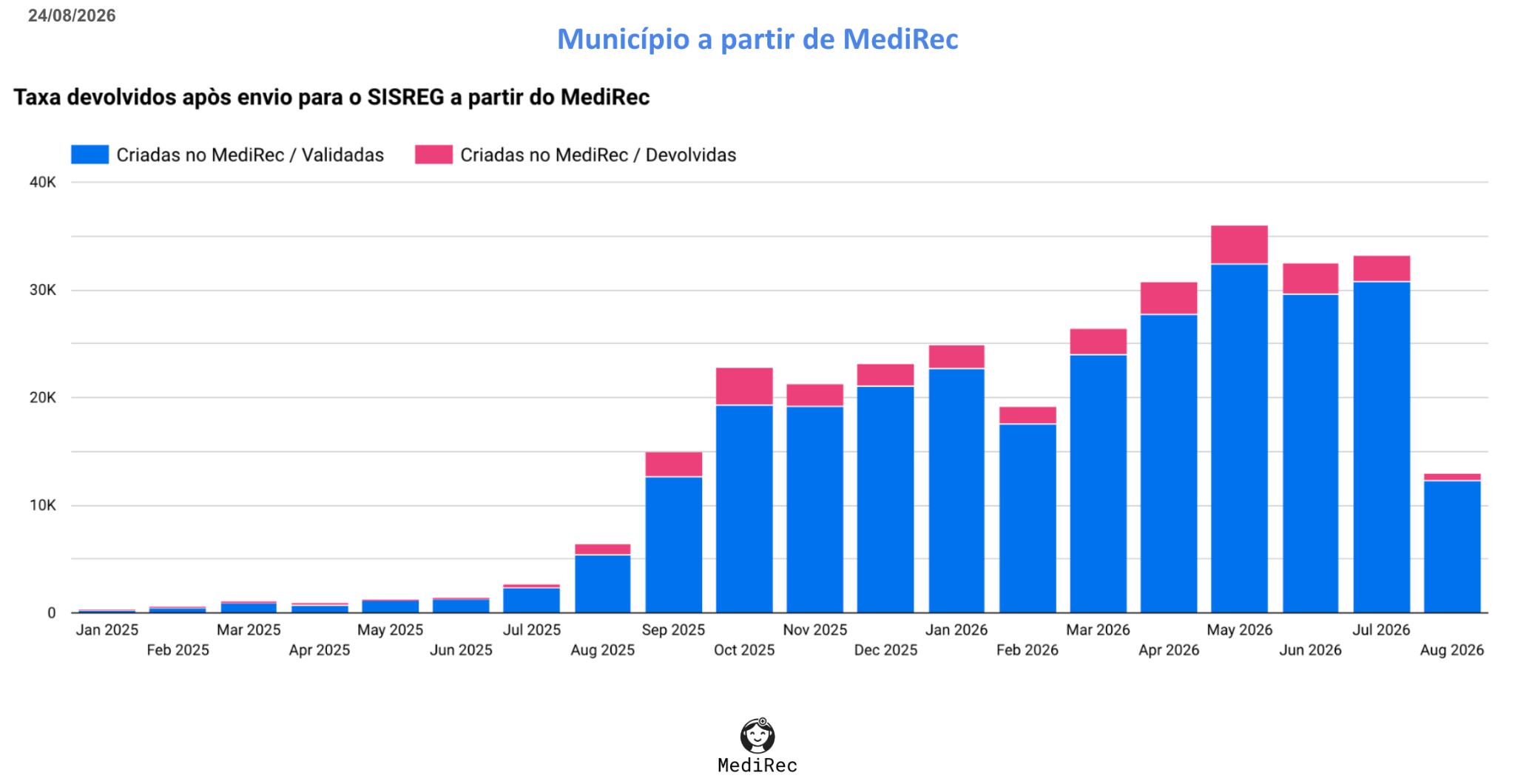
At the municipal level, the return rate through SISREG is 20.97%, compared with 9.74% through MediRec. The data refer to the period from January 2025 to August 2026 and cover 495,400 referrals submitted through MediRec and 4,522,073 directly through SISREG. Because this interval includes the entire initial implementation period — when MediRec was still present in only a few facilities — the cumulative volume underestimates the platform's current share, which is now substantially larger and continues to grow as adoption expands across the network.
In areas and facilities with intensive use, the figures are even better: for example, in Planning Area 2.2, the return rate through SISREG is 15.02%, compared with 5.07% through MediRec.
7. Organic growth
MediRec adoption follows a consistent and organic pattern — despite differences in adoption among areas and facilities, and even with an entire Planning Area (1.0) still not using MediRec. After the initial training, the facility's early adopters — generally the professionals who are more open to and familiar with technology — mobilize spontaneously and become the main users during the first three to four months.
Without the need for additional training, this period is followed by a gradual democratization of use. The milestone of this transition can be identified precisely: it is the moment when the volume of referrals submitted through MediRec exceeds the volume entered directly in SISREG. This transition phase lasts an average of three months, after which MediRec becomes the team's main referral channel.
The success of this adoption process depends largely on the early identification of early adopters within each facility, as well as the active engagement of Medical Technical Leads, Facility Managers, and CAP Medical Technical Leads — key actors in legitimizing and disseminating the platform's use.
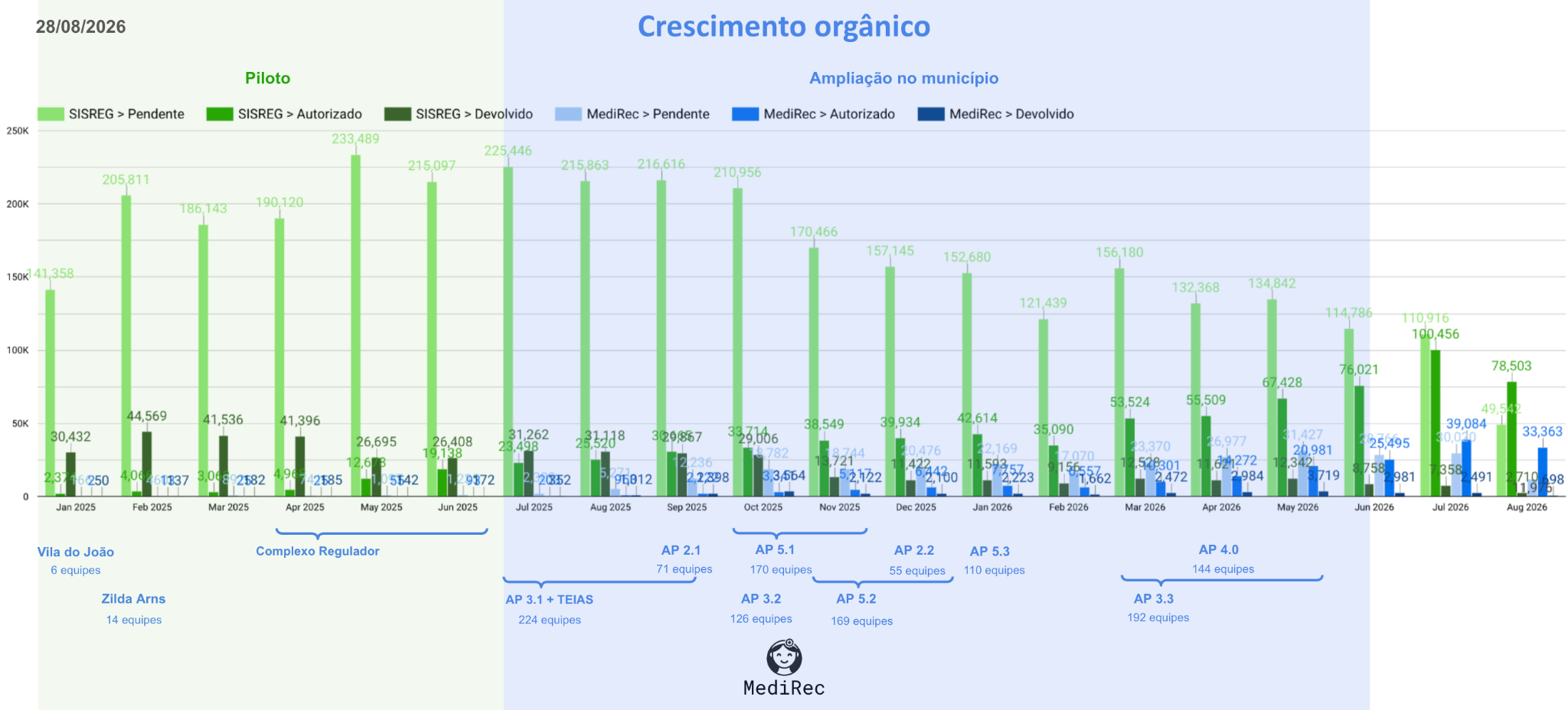
The chart shows the consistent growth in MediRec use throughout the period. From the second half of 2025, as Planning Areas are progressively incorporated, the volume of referrals authorized through MediRec grows rapidly — from residual levels in 2025 to tens of thousands per month in 2026. This advance is accompanied by a significant reduction in pending referrals in SISREG, signaling the gradual migration of the referral channel: requests that previously accumulated directly in SISREG begin to be handled by the platform.
This migration translates into gains that reinforce one another throughout the care pathway. At the request stage, as already shown, MediRec qualifies referrals and reduces the error rate, increasing request compliance at the source. At the return stage, also as demonstrated, automatic assignment and notification of the responsible teams shorten the resolution time for returned referrals, reducing idle time. And at the regulation stage — a dimension not yet addressed in this document — the combination of better-qualified requests and regulator-support tools makes analysis more agile, so the idle time of pending referrals also decreases.
In the most recent months, the volume authorized through MediRec approaches the volume processed directly through SISREG, indicating significant progress by the platform as a referral channel, even though direct SISREG remains the majority channel across the network as a whole. Finally, it is worth noting that this growth in volume is not accompanied by a proportional increase in returns: referrals returned through MediRec remain systematically low throughout the series, even as the total volume handled by the platform grows significantly.
8. Conclusion
MediRec represents a structural change in how public health network facilities manage their access-regulation processes. The results presented in this document are not projections — they are measurable evidence gathered in the field, in the facilities and areas already operating the platform.
Above all, this second edition confirms what the first had already indicated. The trends observed a few months ago have not only been sustained but consolidated: professionals' time savings, the reduction in the returned-referral backlog, the decline in the return rate, and the organic growth of adoption recur consistently — even in the face of differences in adoption among areas and with an entire Planning Area still outside the platform. The robustness of these results, observed in such different contexts, is the best evidence that this is not a one-off effect but a structural pattern.
At the same time, what was already good became better. Advances in our integration infrastructure reduced referral time from approximately 20 seconds to only 6 — further increasing care-time savings and reinforcing gains that were already significant. The continuous improvement of the technology, built side by side with the front line, ensures that each new version of the platform returns more time to patient care.
Finally, MediRec has ceased to be only a regulation tool and has become a platform for coordinating care in the territory. The incorporation of new modules — especially those focused on health surveillance — extends its reach beyond referrals, supporting teams in actively monitoring cases, prioritizing actions, and integrating regulation and surveillance. It is at this point that the platform reveals its greatest potential: when the CAPs and the network's central bodies take ownership of it, MediRec is transformed from a system into a living part of health processes.
This commitment finds concrete expression in the Technology Ownership Program, which offers the network a path to operational autonomy: the possibility of a perpetual license of use, with the source code held in custody, preserving the public administration's right to use the platform. It is a model consistent with the co-constructed nature of the solution, oriented toward building public capacity and assets instead of dependence.
This does not mean that the process is complete. Adoption remains uneven among areas, an entire Planning Area remains outside the platform, and some of the planned integrations are still under development — current limits that also represent the margin of gains still to be realized. As the network expands its coverage and new modules enter operation, the gains multiply: more qualified referrals, more timely surveillance, shorter patient waiting times, and more transparent, data-driven territorial management.